
Spread a 'Little' Happiness (2021)
Quick Book
Please choose a production
| The Sooty Awards: End of Year Celebration | Leicester Drama Society |
| The Girl On The Train | Leicester Drama Society |
| Sweeney Todd | KW Productions |
| New Directors Showcase 2026 | Leicester Drama Society |
| Art | Leicester Drama Society |
| The Elton Story – A Tribute To Elton John | |
| Backstage Pass | |
| Jonny Cole: Armagudd’n | |
| Ceri Dupree: Frock With Laughter | |
| The Sounds of Simon | |
| Legends of Motown | |
| Supersonic Queen | |
| The Great British Bake Off Musical | LAOS |
| LDS MEMBERS – The Big Little Quiz | |
| Night Must Fall | Leicester Drama Society |
| Season’s Greetings | Leicester Drama Society |
| KPAOS – The Soundtrack To Our Story | KPAOS |
| Acting Workshop Beginners / Intermediate | LDS |
| Acting Workshop Advanced | LDS |
| Mother Goose | Leicester Drama Society |
| Dance Central’s Annual Show 2027 | |
| Al Compas Del Querer – Flamenco | The Daniel Martinez Flamenco Company |
| The Same Faces: Improvised Comedy | |
| A Tribute to Sting and The Police | |
| Till The Stars Come Down | Leicester Drama Society |
| The Spongebob Musical | King Productions |
| LGS Big Band | Leicester Grammar School |
| Fleetwood Unchained | |
| The Big Yellow Tambourine Man Band: A Tribute to Joni Mitchell & Bob Dylan | |
| Jersey Beats – Oh What A Nite! | |
| The Dazzling Diamonds: The Comedy Variety Drag Show 2027 | |
| Alfie Moore – Acopalypse Now | |
| Lilies On The Land | Leicester Drama Society |
| The Upbeat Beatles | |
| The Carpenters Experience | |
| Swing From Paris |
Spread a 'Little' Happiness (2021)
Reviews of all Main House Leicester Drama Society shows can be found below by following the link to the relevant show. Reviews are carried out by an independent reviewer who is not an active member of the Leicester Drama Society. If you are interested in becoming a reviewer, then please contact the theatre office.
Witness for the Prosecution (September 2024)
Leonard Vole befriends a wealthy older woman, Emily French, but becomes the chief suspect in her murder. Did he do it?
Ruth Cheetham directs this fantastic play hinging on assumptions – foreigners are liars, lower class people are untrustworthy, and women don’t know anything, to name but three – where the audience takes on the role of the jury, presented with evidence (whether real or fabricated) as to why Leonard Vole should be found guilty of murder. As the prosecution and defence argue and debate with each other over Vole’s innocence, the audience are pulled this way and that. It’s a twisty-turny thriller and being written by Agatha Christie, that’s not much of a surprise, but Cheetham directs the heck out of it and it was, quite simply, fabulous.
Freddie Dobrijevic gives the performance of his life as chief suspect Vole. I’ve seen Dobrijevic in many a play and it’s fair to say he’s quite often the comic relief, the “silly goose” character … until now. By turns cheeky charmer, simple do-gooder and actually pretty sinister, Leonard Vole is unlike any character Dobrijevic has played before, and he gets it bang on.
Another (very pleasant) surprise for me was David Lovell as Sir Wilfrid Robarts QC, Vole’s chief defence. Lovell is another actor I’ve seen in many plays but he never seems to have been given much before that really showcases off his acting talents before. And boy, does he have the talents to pull this role off! The man is a force of nature, bantering with speed against leader of the prosecution Mr Myers QC (played excellently by Charles Moss), quick wits firing on all cylinders against Vole’s tricksy wife Romaine (played to beret-wearing perfection by Leeann Rana) and cajoling the full story out of Vole in their first meeting.
Exceedingly high praise should also be given to Jon Worthy (playing Vole’s beleaguered solicitor Mr Mayhew). His tired professionalism is perfect for the character, of course wanting Vole to get off scot-free but with a realistic outlook that he probably won’t. Worthy is a fantastic actor who really needs more roles to shine in.
Charles Moss and Leeann Rana were, as previously stated, absolutely perfect for their roles. Rana really gets into her role as Romaine (a German actress who Vole rescues from Russia’s Berlin sector). Romaine is Vole’s only alibi and it’s really her statement that will set the judgement one way or the other. Sassy, flirtatious and a nightmare to question in court, Rana clearly enjoys her times in the witness box (as she should!). Moss plays the swaggering prosecution to perfection, sweeping about the stage and battering down Lovell’s QC with every retort. Moss didn’t miss a beat, and you could have cut the tension between he and Lovell with a knife, ever-so-politely saying “m’learned friend” to each other while clearly wishing them a horrible death.
Carolos Dandolo was on top form as Judge Justice Wainwright, presiding from on high and displaying a lack of knowledge around cat grooming (watch the play, you’ll understand this) while also making it clear he has a penchant for blondes. Although the play is a drama, there are a lot of comedic lines, and Dandolo clearly makes the most of the ones he gets.
Credit should also be given where it’s due to some actors in small, rather thankless roles, with either no lines to say or exceedingly little. Darren Wright and Thom Jones (as policemen/court officers), Steffi Parker (Judge’s Clerk), Michael Bull (Alderman), Nick Sheard (Warder), and Eve Hopkins and Jemima Moulder as Paper Sellers. The paper sellers and the policemen got to mingle around the foyer before the play started. When that happens, you know you’re in for an evening of the unexpected. Congratulations to you all!
Carla Smith, in her first LDS role, has the rather unenviable job of opening the play with usual announcement about no photographs, no mobile phones etc. Director Ruth Cheetham has rather ingeniously done away with the recorded announcements and, as the Clerk of the Court, it makes sense that Smith should be the person delivering the message live and in a suitable clerk-y fashion. You wouldn’t know this is Smith’s first LDS play, as she has a superb air of confidence and never wavers (even when the Judge is banging his gavel perilously close to her ears).
But still, as incredible as the cast were, they would be nothing without the technical elements that bring the play together. Scenic Designer Nadine Hall has gone full-out on making a replica courtroom on the stage, seating the judge up high to look down on the lowly defendant. Atmospheric sound and lighting (from Andrew Northcote and Andy Crooks respectively) really ratchets up the tension. Set changes – carried out by members of the cast as well as the backstage team in suitable costume – were slick and didn’t detract from what was going on.
My only fault with this play (and there had to be one, I’m not that easy to please) was the Foreman of the Jury. With every single other character being played by a live person on the stage, why have the Foreman be a recorded voice? Why not actually put someone in the audience? The play is actually quite immersive and it was a weird jolt back to reality to have the Foreman not be a character who is present in the room. Still, this was a minor quibble with a play that was overall outstanding.
A wordy play that was never boring, Witness for the Prosecution was a fantastic evening out at the Little Theatre. I’ve not seen an audience this responsive – gasps, boos and exclamations – since panto. Well done to all involved!
Five stars. Case dismissed.
★★★★★
The Secret Garden: The Musical (March 2024)
Reviewed by Lynette Watson
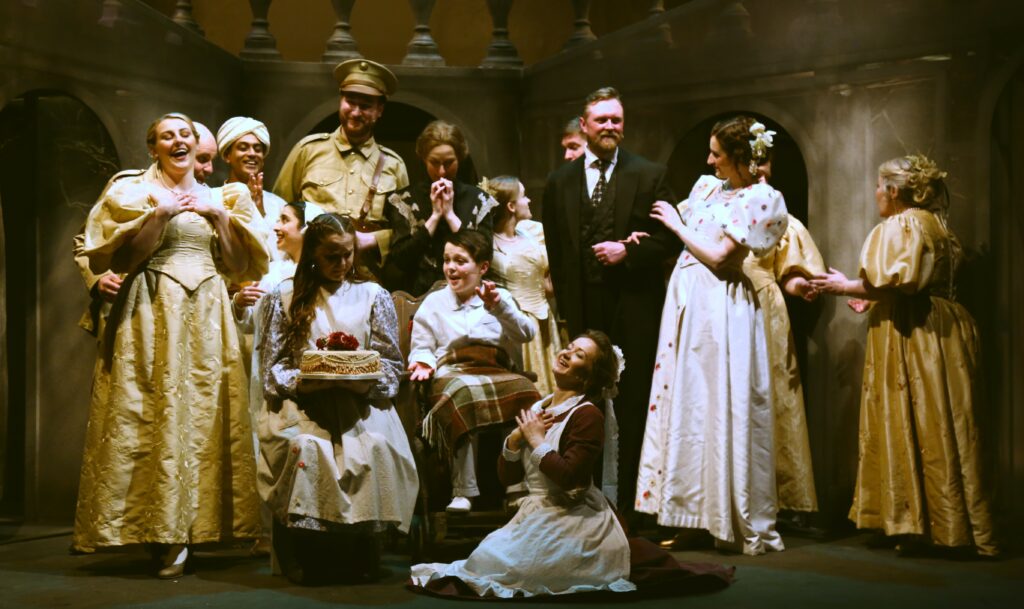
Based upon the popular children’s book, The Secret Garden by Frances Hodgson Burnett, the latest musical version by Marsha Norman and Lucy Simon, and adapted by Leicester Drama Society raises the bar, with a tremendous cast as it begins its run at Leicester’s Little Theatre.
At the centre of the story is the recently orphaned Mary Lennox, sent from India to live with her uncle, Archibald Craven, in Yorkshire. Archie has become a recluse, still mourning the death of his beautiful wife, Lily, who appears throughout show as a ghost, and leads to Mary’s discovery of her neglected walled garden.
The outstanding ensemble were able to follow this story through a complicated score – both dramatically and vocally beautiful – with no weak links in the company. The first act is full of mystery, as the characters establish themselves against a static split-level set with a plethora of arches, transporting the action from India to Yorkshire, on to Paris, and back to Yorkshire and a transformed magical garden! During the second act, Mary and her cousin Colin (wistfully played by Edward Lander, a role shared with Harry Woodward) join forces, and with help from Martha (Kerry Smith), Dickon (Simon Butler), and Ben Weatherstaff (Martin Bell) bring the secret garden back to its former, colourful glory. This emphasises the underlying theme of the story that after times of despair, with tender nurturing, love and family relationships can be restored.
All the twenty-strong ensemble give impressive and moving performances, with a superb, committed delivery from Keiran Whelan-Newby as Archibald, and by a young star in the making, Olivia King, as Mary – confident and believable throughout. There are many memorable musical numbers, but two that stood out for me were, in the first act, ‘Lily’s Eyes’ (performed by Whelan-Newby and Russell Webster) and the hauntingly poignant, ‘Come to my Garden’ (performed by Rose Bale) during the second.
The Leicester Drama Society production of The Secret Garden is truly special and provides the perfect outing for the whole family this Easter.
_ _ _
This production received several other generous reviews that can be found online:
★★★★★ – East Midlands Theatre
★★★★★ – What’s Good To Do
★★★★ – Theatre&Tonic
★★★★ – Niche Magazine
“A very impressive production with some excellent performances that elevate it further. It’s moving and emotive and Leicester audiences should flock to this garden of wonder this Easter.” – Beyond The Curtain
Photo by Dave Morris.
Puss in Boots (December 2023)
Reviewed by Lynette Watson
A dazzling Christmas cracker of a show bursting with glitz and glamour plus an upright, walking talking feline clad in magical red boots has arrived at Leicester’s Little Theatre, delivering their ever popular and always traditional pantomime. This year being – yes, you’ve guessed it – Puss in Boots.
This classic tale, adapted by the man of many talents, John Bale, follows the journey of two millers’ sons who have been stripped of their inheritance by the evil wizard Malavort (Joe Middleton). Having been left with only with their faithful cat, the poor eldest brother Tom (Simon Butler) struggles to gain the hand of Queen Camilla’s (Bale) daughter, Princess Lilly (Alice Marshall), in marriage. Pantoland collides with Catland in this beautiful, colourful show, as the Spirit of Catland (Natasha Carr) grants Puss with magical powers to save the day.
The entire cast ensure the pace never drops throughout. In true pantomime style, it’s packed with the usual corny jokes, clever plays on words, and a plethora of panto staples, including the ‘convenient bench’ making its annual appearance. It never fails to have the kids absolutely going mad… they loved it, cheering and booing from the start – their enjoyment was palpable!
In the title role, Rose Bale strutted around with confidence and her vocals were pitch perfect. Butler and Marshall made an endearing couple as Tom and Princess Lilly, and were well countered by the manic-laughing of Joe Middleton, suitably evil as Malavort.
Back to Queen Camilla, and John Bale revels in his role as the dame, superb as ever in the hilarious costumes that evoked applause at every entrance. His double act with Fusspot, the Lord Chamberlain (Russell Webster) was excellent. Their Torvil and Dean Bolero dance was one of the highlights of the show, beautifully passionate but utterly ridiculous.
The spectacular finale is a pure visual delight, and if you can only visit one pantomime this year, venture no further than The Little Theatre. It’s a fun-filled, festive family treat, and I guarantee you will love it.
Home, I’m Darling (May 2023)
Reviewed by Alex Thompson
As director John Ghent asks in his programme notes “How would you like to turn back the clock and live in the 1950s?”
As someone that was born in the nineties, I immediately imagine those incredible patterned wallpapers, the nine-to-five man in a suit and the domestic goddesses with a permanent painted smile. And indeed this is the life lived by Judy (Caitlin Mottram) and Johnny (Gary Hunt) who are the very embodiment of that rose-tinted 1950s life. But peel back that perfect picture just a little and it becomes obvious that life post-war wasn’t all the glitz and glamour that modern media lets us believe.
This season’s LDS shows have seen some of the most incredible sets I have seen – some scarcely believable for a theatre this size – and Home, I’m Darling continues this streak. Upon entering the auditorium, you are instantly taken back to that idealised 50s home, back to a time were going to the theatre to watch a play was a staple of many couples’ lives. The detail shown by set designer Al Davis to create this perfect 1950s house is immaculate, from the multi-coloured patterned floors and rugs to the tiny TV located in the cupboard. The pre-show announcement reminding us to keep our modern tech on silent is humorous and beautifully sets the scene.
Whilst Judy and Johnny seem to be living the perfect 50s life, it soon becomes clear something isn’t quite right. In fact, the end of the opening scene was so startling it drew audible gasps from the audience as people turned to their parties stunned. I won’t go into the fine points of the plot so as to avoid spoilers, but writer Laura Wade conducts a very fine balancing act, allowing this bygone era to exist side-by-side with modern themes such as feminism, gender and power, whilst never forgetting this is a comedy at heart. The spinning of these conflicting plates could end in disaster with a less experienced director, but John Ghent does a wonderful job of getting the right balance, resulting in a production that is both side-splitting and thought provoking, often at the same time.
The undoubted star of the show is Mottram as Judy. Portraying a woman who is on the verge – or quite possibly in the middle of – a mental breakdown as her perfect life crumbles all around her, every emotion is played wonderfully on Mottram’s face as she tries to keep her feelings below skin deep like a good little 50s housewife. Hunt compliments her as the always charming Johnny, before his mask begins to slip too. Their chemistry is entirely believable and has you rooting for the characters throughout, despite their obvious flaws. They are accompanied by Tracey Holderness and Laurence Jackson as friends Fran and Marcus, both of whom deliver some incredibly funny one-liners (Jackson in particular has a very high line-to-laugh ratio) and Becky Orton as Alex, whose power oozes through every time she’s on stage. My special mention however must go to Elaine Rook as Judy’s mum Sylvia, who delivers an incredible monologue in act two that was rightly given an ovation.
It would also be amiss not to mention the always-on-point era-appropriate costumes provided by John Bale, and the sheer number of props accumulated by the properties team to make this seem as close to 50s life as possible. A natural by-product is slightly longer scene changes are required but these will likely get quicker as the week-long run progresses. In fact, the changes got noticeably quicker as the performance went on thanks to the efforts of the stage team and dressers.
Upon leaving there was a beautiful buzz in the theatre and the chatter I heard from the patrons was overwhelmingly positive. Home, I’m Darling is a delightful production that will have you yearning for a simpler time whilst appreciating how far today’s world has come in perfect harmony.
The Railway Children (March 2023)
Reviews for our family show
“A delightful treat for families of all ages to enjoy over the Easter period.” – What’s Good To Do
“Pure, charming and uplifting period drama escapism.” – Niche Magazine
Bedroom Farce (March 2023)
Reviewed by Lynette Watson
Four into three won’t go, except in Bedroom Farce, Alan Ayckbourn’s hilarious, award-winning play about marital disharmony.
The unique setting for this play is three bedrooms (hence the title), with all the action taking place at the same time, all visible on stage, with the focus moving from bedroom to bedroom as the plot unfolds across one night and the following morning.
Bedroom one is the domain of older couple Ernest and Delia (Adam Jones and Karen Gordon), whose marriage has descended into a comfortable relationship their chief excitement being eating pilchards on toast in bed rather than anything romantic.
In bedroom two, we find a cantankerous bedridden-with-a-bad-back Nick (Jordan Handford) and long-suffering wife Jan (Diani Gatenby Davies) putting up with each other.
In the third bedroom, the younger Malcolm and Kate (Simon Butler and Rachel Humphrey) – who appear to be the most well-adjusted – begin to realise that some elements of their marriage are not what they seem.
All three couples are interlinked by the neurotic, unhappily married Trevor and mantra-repeating Susannah (Andy Longley-Brown and Helen White), either as parents, former lovers, or friends who invade every bedroom throughout the play, leading to chaos and mayhem.
There are no weak links in the eight strong cast, all delivering the important and necessary contrast between the couplings. Little Theatre stalwarts, the dependable regulars Jones and Gordon easily bounce off each other as Ernest and Delia making the most of the comedic one liners Ayckbourn had reserved for them.
Gatenby Davies’ character grows from a slightly tentative start into the believable fed-up wife who could have been married to Trevor, while Handford’s Nick delivers a moment of pure comedy gold by falling out of bed moaning, resulting in the single sorrowful word ‘help!’. An example of Ayckbourn’s spot on observations of people.
Committed performances were given by Butler and Humphrey while both Longley-Brown and White were ridiculously hilarious.
Director Mary Jones ensured the pace never dropped in this slick, engaging situation comedy; a true Ayckbourn classic and the audience certainly agreed. I guarantee it’s a pure treat of an evening out.
The York Realist (February 2023)
Reviewed by David Moore
Recently voted as one of the best plays of the century, The York Realist had its last major outing as a joint staging at the Crucible, Sheffield and the Donmar Warehouse, London in 2018. Written just 20 years ago by Peter Gill, it is set in an impoverished farm cottage in rural Yorkshire in the 1960s.
I saw it on opening night at The Little and was transported to that farm cottage scene; its single combined kitchen and living space, with an old black range cooker as the centrepiece and only source of physical warmth for George and his mum who live there.
The core story is farm-hand George’s love for middle-class theatre director John, up from London, who is director of a series of biblical plays in York, in which George is treading the boards for the first time. Straight-talking Yorkshireman George (John Moulding) sees his visiting sister (Victoria Flowers), brother-in-law (Paul Beasley) and their son (Joshua Thompson) for tea – Yorkshire Tea one hopes – whilst yearning for John (Joe Allen), who makes calls to the cottage to see him. Doreen (Natalie Tebbutt) is a kind-hearted friend who also visits to entice his mum (Sue Dale) out to a chapel evening.
The play reveals George’s relationship with John and its many tensions: working class vs middle class, north vs south, rural vs city and life as a gay man in a straight and deeply religious family. Of course, homosexuality was illegal in the 1960s.This is all delivered through joyful Yorkshire dialogue.
Gill time-shifts an early scene – which was a little confusing, but you soon realise why – and I found myself engrossed in the play as it progressed, keen to learn how George and John tackle their different backgrounds and tensions, and of course to hear what happens to them.
Despite being set in the 1960s, The York Realist seems so up to date, reflecting many of the same conflicts and challenges that we see today. Contrast how the play depicts chapel-going Mum and Doreen alongside the biblical plays staged by George and John, with how our present-day Church of England has rejected same-sex marriages in their churches, despite these being made legal in the UK some eight years ago.
On at The Little for the rest of this week, this is drama at its best and a real slice of 60s Yorkshire, around many cups of tea. A warm yet poignant play that engages throughout.
Alphabetical Order (October 2022)
Reviewed by Lynette Watson
Alphabetical Order is set in a 1970’s library office of a provincial newspaper – a scene of permanent and utter chaos – that issues constant moral support for needy journalists, run by head librarian Lucy (Emma Bamford), a disorganised earth mother in total disarray, she attempts to bring some semblance of order by recruiting Lesley (Rachael Humphrey), a young assistant with a passion for organisation to do just that.
Writer Michael Frayn divides his play into two distinct halves, as Act One – with its obvious camaraderie between all the quirky characters – is transformed by Act Two into a library that is exemplary in tidiness, but completely lacking in soul.
Bamford and Humphrey equally matched each other in strength, as they crossed swords to achieve office supremacy, although both lost some audibility at times, especially at the conclusion of Act One.
While the conflict of the two librarians is the centrepiece, the rest of the cast in Lucy’s den are well suited to their characters. Notably, John Moulding as the indecisive taciturn John, who gave a believable, understated performance, and Ali Levy as the dithery and motherly feature writer, Nora. Charles Moss was a breath of fresh air as Geoffrey, the jovial ageing newspaper ‘boy’ who delivered some much-needed comedic moments!
Credit to Gem Greaves, whose set authentically echoed the 1970s, and hats off to costume designer John Bale – who can forget those Fair Isle tank tops, flowered midi skirts and flared trousers… hilarious!
Frayn himself says the play is really about ‘the interdependence of order and disorder’ with too much of one making you long for the other’ – food for thought. The production succeeds in offering a fitting tribute to a play that is very much of its time in the non-digital age.
The Secret Diary of Adrian Mole (Aged 13 ¾) (September 2022)
Reviewed by Tom Young for Niche Magazine
It’s been three years since Leicester Amateur Operatic Society (LAOS) brought a show to a Leicester stage – their first post-pandemic offering has a local connection.
Sue Townsend’s novel is charmingly adapted into this Leicester-set musical, centred around the musings of self-described-intellectual teenager, Adrian Mole. Taking place in one year of Adrian’s life – as described in his diary entries – it explores first crushes, parents divorcing, dealing with bullies, and the perils of teenage life.
Like Billy Elliot, Matilda, and Oliver! before it, Adrian Mole’s central question boils down to: can you find a young actor capable of carrying the show? In Zach Ball, the answer is yes. The son of Siobhan Ball – who starred in Calendar Girls at The Little Theatre earlier this year – show business clearly runs in the family blood.
Ball delivers a very mature performance (ironically), with an impressive vocal range capable of tackling the show’s toughest numbers. His characterisation is also solid, giving Adrian a nuanced balance between over-confidence and awkward shyness.
To read the rest of the review, click here.
.
Black Coffee (September 2022)
Reviewed by Lynette Watson
Poison, murder, a missing formula, and secret identities.
A shoal of red herrings face Hercule Poirot, the intrepid Belgian detective, in Agatha Christie’s murder mystery ‘Black Coffee’ – the latest production at Leicester’s Little Theatre.
The play centres around the theft of eminent physicist, Sir Claude Amory’s explosive formula. Having summoned Poirot to his house to uncover the thief, the plot darkens when Sir Claude is dispatched by poisoned coffee. Poirot not only has to unmask a thief but a murderer as well.
The story unwinds slowly at first, however the action really begins to come into its own with the arrival of Poirot and his trusted friend Captain Hastings.
Each character has the spotlight cast upon them in turn, with every member of the Amory family having their chance to look capable and guilty, as well as a mysterious Italian doctor. As their secrets are confessed, your mind jostles from suspect to suspect, as you try to decide who the actual villain is!
There are some delightful characterisations from the talented 13-strong cast with no weak links. Some are new to the Little Theatre stage, though a few reliable regulars include Karen Gordon as Miss Caroline Amory, a scatter-brained, stiff upper-class lady, and Rose Bale as her niece Barbara – a lively and slightly eccentric girl.
All delivered believable performances, but the night belonged to Michael King as Hercule Poirot – although new to the LDS, he is an accomplished actor and brought a freshness to the role as he scuttled around the stage, delivering his typically dry lines, peppered with comedic moments: a terrific performance.
Black Coffee hits all the right notes and the near-full audience loved it – so who committed the murder? Only one way to find out!
Scheherezade’s Arabian Nights (June 2022)
Reviewed by Lynette Watson
The latest production in Leicester’s Little Theatre centenary year (1922-2022) is the colourful and magical Arabian Nights, and when it comes to storytelling it does not come more epic, as every one of the tales has a moral attached that are certainly relevant today.
The book was originally entitled One Thousand and One Nights as it referred to the number of stories Scheherazade, a woman, the main storyteller, had to relate in order to save her life. Based on folktales handed down from generation to generation, the plot begins with Sultan Shahryar who, after killing his wife because of her adultery, vows to marry a woman each night, but have her executed the following morning. Enter Scheherezade, who stays alive by telling him stories that hold his attention and leave him desperate to hear more – she delivers a new tale every night in order to save herself… and eventually she does!
In this cleverly adapted version by director Jeremy Thompson and co-author Jane Rowland, the audience were treated to just four tales, ‘The True Heart’, ‘The Leg of Mutton’, ‘The Fisherman and the Brass Bottle’ and ‘Ali Baba and the 40 Thieves’, all brought to life with dialogue, dancing and imagery, plus a few special effects thrown into the mix, set against a minimalistic background including a real water fountain, minarets and a ‘sesame’ opening cave, and a lavish and plush Sultan’s throne.
With the nine strong cast being a mixture of new and experienced actors, all playing multiple roles, there was some inconsistency of diction, energy and stage presence, but this tentativeness gave way to more believable performances as the pace picked up in the second act. Joe Middleton was suitably evil and commanding as Sultan Shahryar, while Tanzim Saiyara worked hard throughout as the storytelling Scheherezade: I felt she could have almost hypnotised Shahryar with her constant snakelike movements when relating the tales. Robin Turner and Michael Holland, each playing seven roles, bounced off each other beautifully, Robin giving an hilarious impromptu improvisation trying to extract a prop from a tangled fishing net.
Arabian Nights offers a treasury of tales illustrating honesty over cruelty, happiness over riches, intelligence over brute force, not forgetting the power of true love. An enjoyable and uplifting show that was certainly well received.
Calendar Girls (June 2022)
Reviewed by Lynette Watson
Calendar Girls The Musical, presented by KW Productions at Leicester’s Little Theatre, is the collaborative adaptation by Take That’s Gary Barlow with the original writer Tim Firth. It is a truly heart-warming production from start to finish. It’s over 20 years since the story of a group of innovative women from a Yorkshire branch of the WI, including one member a widow (Annie) of a leukaemia victim, shed their clothes to pose for a nude calendar in order to raise money. The book was turned into an award-winning film and stage play, and in 2015 was given a new lease of life as a musical thanks to Barlow and Firth. And what a fabulous musical it is, by effectively adding another dimension (including a new plotline of young love between two teenagers) to the remarkable story we all love.
The opening ensemble song Yorkshire, set against a beautiful backdrop of the Yorkshire Dales, reminds us that we are in the small village of Knapley, and how the close knit community comes together after the loss of village stalwart John Clarke. Directors Keiran Whelan-Newby and John Bale have assembled a superb cast, all with tremendous singing voices and expert comic timing. The six lead females make their characters – each with their own individual life problems – believable, as do the rest of the supporting multi-talented cast, reinforcing the theme of togetherness… brilliant to see!
And so to the cast itself… as Annie, Alexandra Elliott gave a affecting performance and her song ‘Kilimanjaro’ was sung with true emotional poignancy, highlighting the loss of your other half. As Chris, Annie’s best friend, Siobhan Ball delivered a dynamic performance with a tremendously impressive vocal range; Debbie Longley-Brown shone as Cora, a single mother both hilarious and touching. Liz Kavanagh Knott as Celia revelled in her fun song ‘I’ve Had a Little work Done’, and Tracey Holderness as Ruth was hilarious in her drunken scenes. However, Jane Towers as Jessie takes the honours for the best one-liners, such as ‘no front bottoms’ – brilliant stuff.
Apart from the main characters this really is an ensemble piece, and the whole cast – including the younger members – brought energy to a production that is humorous, heartfelt, a little bit naughty, but sincere and empowering. Calendar Girls is a celebration of life and deep-rooted friendships, is fun, has an excellent cast, is a fantastic show… and it fully deserved its first night standing ovation!
A Comedy of Tenors (June 2022)
Reviewed by Kate Donovan
You need a good audience for a comedy, and it was great to see a well populated theatre with people in high spirits at the opening night of A Comedy of Tenors. Right from the outset, there were laughs to be had as the characters eased into their tomfoolery.
The show is set in one hotel suite, the design of which was very impressive for the audience to see even before the show started. Designed by professional scenic designer Phil Newman, there were lovely 1930s Art Deco design touches, and the view of the Eiffel Tower through the bedroom window made me believe that I too was in the heart of Paris.
The synopsis for A Comedy of Tenors sums it up perfectly; one hotel suite, four tenors, two wives, three girlfriends, and a soccer stadium filled with screaming fans. What could possibly go wrong? Well, almost everything! There are falling outs, falling overs, fallings in and out of love… all peppered with a soundtrack that even if you’re not into your opera, you will recognize from the wonderful music played. And, even more enjoyable, was the really strong harmonsied singing at the end of the first half by the three tenors (Tito, played by Steve Illidge, Carlo, played by Alex Thompson, and Max, played by Simon Butler). A big round of applause was very much deserved.
Classic capers of one actor, Illidge, playing two roles were central to this show – leaving through one door in one costume, re-entering through another door in a different one – simple looking comedy moments that take a good director (Martin Bell) and a great backstage crew to help pull off seamlessly.
Whilst all of the actors put on a good first night show, the standout performance for me was by Laura Brookes who played the Russian soprano, Racon. Laura stole the show in the second half with her incredible singing voice and her comedic display of passion for tenor, Bepo, the bellhop who happens to be Tito’s doppelganger.
The final scene of the play is a clever mix of props and lighting, giving the impression that the singers are going out onto the big stage for their performance. A reprise of the cast all singing together was a pleasure to hear.
Any kind of comedy is difficult to pull off well, and yet there was plenty of fun had in The Little Theatre last night. As the cast play out their week, I imagine the show will only get funnier each night that they perform.
Rabbit Hole (May 2022)
Reviewed by Kate Donovan
Rabbit Hole, a play by David Lindsay-Abaire, is set eight months after the tragic, accidental death of a four year old child. And whilst this sounds like a tricky subject to tackle on stage on a Monday evening, it was beautifully delivered on its opening night by the current cast at The Little Theatre.
This heartfelt drama, lightly comedic in part, delves into how parents Becca and Howie (wonderfully played by Kat Lenthall and John Moulding) cope with the grief of losing their son, Danny. Howie wants to keep hold of all the memories and keepsakes; Becca is trying to find a new life without constant reminders of her son. Theirs, and their wider family relationships, are all tested, and the brilliance of the play is that its dialogue is so well-observed, while demonstrating that every person’s grief is unique.
The staging by director Paul Beasley is intimate. There are only five actors in the whole production, but they, complemented by some clever set design, make the audience feel like we’re all sitting in the same living room. Natalie Tebbutt, who plays Izzy, does such a convincing job of being heavily pregnant that at times I wanted to offer my hand to help her get up off of the sofa! Nadine Beasley as Nat (Becca and Izzy’s mum) and Dylan Kelvey as Jason Willette, the young driver of the car that accidentally killed Danny, bring a mixture of humour and pathos to the performance.
Reading the synopsis of the play might make you think that this could be a downer of a night out, but don’t let that put you off. This is an award-winning play that has been brought to life on screen and stages across the globe. The Little Theatre team has done a fantastic job of presenting the show in a heartfelt and touching way. The only thing missing is a full house. This performance is thoroughly deserving of a big audience each night, so if you have a free evening this week, please support your local theatre and go see it.
Dead Guilty (April 2022)
Reviewed by Lynette Watson
Dead Guilty by Richard Harris is the latest production at Leicester’s Little Theatre. Harris has ventured from his usual genre of TV crime writing into the world of psychological thrillers – the result? A play that covers four months in the lives of two women, Julia and Margaret, who both harbour a dark secret. The action begins and ends with an inquest, and between the two acts of many short scenes, we watch the intermediate effects. Set in the 1990s, at first Julia is in a wheelchair and housebound, having been injured in a car crash travelling with her lover when he died of a heart attack. She is assisted by a male home help, Gary, and a seemly ineffectual therapist, Ann.
Enter Margaret, the widow of Julia’s lover, who at first appears fairly innocuous, wanting answers about her husband’s death. But as events unfold, we see a subtle change from someone needy into someone sinister, and finally just plain evil. The ‘awkward’ friendship becomes increasingly dangerous for Julia as Margaret effectively gets Gary and Ann out of the way, leaving her to weald her revenge on her late husband’s mistress.
Julia was played with conviction by Rachel Humphrey as she is slowly ground down by Margaret’s attention and dominance, while Cathy Rackstraw revelled in her performance as Margaret, becoming more believable during the second half as she inhabited the murderous quality of her character. Support was given by Pete Bing as Gary, in his debut performance at the Little, plus Tracey Gosling, prim and proper as therapist Ann.
The single set (very much of the time) was enhanced by the large, domineering, beautifully-lit backdrop of an illusive spider’s web, drawing you into the action, a clever ploy, and each scene change with the emotive music was slick and seamless, a credit to the backstage crew!
Poison is not always a tablet or drug, it can be purely the intangibility of targeting the mind. Harris’s play does this, making you want to know the outcome – which is dramatic and shocking. How? My lips are sealed..!
Up ‘n’ Under (March 2022)
Reviewed by Andrew Thompson
It was nice to see a good-sized audience on Monday night at the Little Theatre. They had come expecting to be entertained by the work of John Godber, one of the most popular playwrights in contemporary theatre, and this first night of Up ‘n Under did not disappoint. The play’s title comes from a phrase made famous by Eddie Waring, the voice of Rugby League through his television commentary in the 60s and 70s, and the play itself conjures up the tough world of Rugby League as played by small local teams in West Yorkshire. The story is one of David versus Goliath; the players from the Wheatsheaf, who have never won a game and can never even field a full team, are up against the Cobbler’s Arms, the top team with a fearsome reputation for crushing their opponents. Up ‘n Under is based on the conceit of the seemingly unwinnable bet, when Arthur, who had previously had some success as a player, rashly bets all his savings that he can train a team to beat the Cobbler’s Arms. The rest of the play is about how he sets about doing this, until we finally learn whether the Wheatsheaf comes good and the bet is won or lost.
Godber cleverly contrasts the macho, raucous and bawdy language of the dressing room spoken and sung by the characters with the more refined language of a pastiche Shakespearian Prologue and Chorus to comment on the action ironically as a battle between the armies of two claimants to the royal throne. But, for all their macho banter in the dressing room, the Wheatsheaf team are used to losing and their training consists in brief sallies onto the rugby field followed by long sessions in the pub. How ironic then when Arthur, in desperation, engages a woman (Hazel) to knock them into shape. After initial hostility and rejection of her serious training regime, and after much hard work, the lads learn discipline and self-belief and even acknowledge that Hazel is “alright for a woman.”
There are strong hints in the play that for some of the characters the habit of losing on the pitch is symptomatic of a deeper loss and lack of self-belief. Arthur, the hotheaded captain and hooker played convincingly by Ben Harris, has been banned from playing for Wakefield Trinity and is trying to find a way back into the game. The team prop, Frank the butcher, has split up with his wife and misses his kids desperately, and Allan Smith brings out this vulnerable side well. The characters of Phil, Steve and Tony, played energetically and confidently by John Moulding, David Jones and Lewis Cole all grow in physical fitness and self esteem under the guidance of Hazel. Through some of the comments by the players it is clear there are themes of male mysogeny at work in the play, though Lynn Moore’s production doesn’t feel the need to draw too much attention to the now clearly outdated macho attitudes and culture evident in the dressing room, preferring rather to emphasise the strong female figure in the play. Nikki Cooper’s Hazel is more than a match for “the lads”, and her interpretation brings to the fore how her character skilfully manages and guides them to greater achievement and self respect.
This cast works very well together, bouncing off each other energetically to create the humour which makes Up ‘n Under so entertaining. Credible Yorkshire accents are maintained most of the time, and the pace is sustained throughout. There is some rather impressive choreography and use of the space on stage to create a final “battle”; this is the rugby match between the Cobbler’s Arms and the Wheatsheaf. Cleverly designed costumes play a particularly important part in this scene, and the actors bring it off skilfully and with real panache. The set is simple in design, but evokes in turn the rugby playing field, the dressing room, a pub and Hazel’s gym, all with minimal props, and scene changes were carried out efficiently without interrupting the flow of the play. The lighting was unobtrusive, but provided seamless transitions supporting the many changes of scene and mood. Music was used to particular effect, with well-chosen themes evoking the time in which the play was written and set – it premiered in 1984 – and also to provide a humorous commentary on the action. This was a strong first night for a very entertaining production which will go from strength to strength as the week progresses. It was applauded loudly by an appreciative audience.
A Bunch of Amateurs (February 2022)
Reviewed by Lynette Watson
Comedy writing duo of Ian Hislop and Nick Newman’s A Bunch of Amateurs was originally written for the big screen in 2008 and premiered in that same year’s Royal Film Performance. It was an instant success, especially with HM the Queen, who asked for a screening of it during Christmas at Sandringham. The stage adaptation wasn’t released until several years later.
In a nutshell, the plot revolves around an amateur theatre company called The Stratford Players, who are rehearsing Shakespeare’s King Lear and desperately want to obtain a famous star to take the lead, in order to save their local theatre from closure. They manage to contact Jefferson Steel, an fading American film star, who is eager to revive his declining career; he agrees to take on the part, believing it to be for the Royal Shakespeare Company in Stratford itself, only to discover he has been tricked by his agent – arriving in the sleepy village of Stratford St John – resulting in egos, vanity and sparks flying when the professional and amateur theatre worlds collide!
There are always some beautifully drawn characters in Hislop and Newman’s work, and the cast worked hard to inhabit their roles and make them believable; but, as so often with farce, the plot itself determines a certain suspension of disbelief, and they only just about managed to achieve it. At the centre of the action, Jefferson Steel was played by Steve Elliott with the right amount of cynicism and vanity, and his gradual transition from the egotistical star to addressing his personal demons with humility was a delight to watch. He was equally matched by talented Leeann Rana as the company’s director, Dorothy, dealing with Jefferson’s celeb demands with ease, eventually leading to the possible romance between them. Nigel, a company member, is Jefferson’s rival and desperate to play Lear himself; he constantly boasts about his acting ability and is one of those annoying and pompous characters we all encounter at some point. As Nigel, the ever-reliable David Lovell delivered a skilful performance, taking the melodrama up to the wire without actually tripping over it… and also giving a masterclass in theatre projection! The rest of the small cast gave strong support, and the interspersing of the scenes with the Shakespearean quotes worked well with the atmospheric lighting against the minimalistic wooden barn set, adding to the structural element of the play.
Co-writer Nick Newman states the play’s theme is about the redemptive power of the theatre – let’s hope in this current climate that this theme rings true.
Handbagged (February 2022)
Reviewed by Andrew Thompson
Moira Buffini’s Handbagged was written in 2010, twenty years after Margaret Thatcher stood down as prime minister after three consecutive terms in office. Between 1979 to 1990 she met the Queen weekly, and the play imagines what the relationship between the two most powerful women in Britain was like behind closed doors as it developed over eleven years, the longest period in office of any British prime minister in the 20th century. We follow the course of Mrs Thatcher’s premiership in the ‘80s with the Queen and Maggie each providing their own view of key events to demonstrate how they had influenced things decisively for Britain, but in so doing tensions between them are exposed. A struggle between powerful egos emerges as do growing clashes of ideology between a prime minister who famously said that “there is no such thing as society” and a monarch who had vowed to serve that society.
We are introduced to a Younger Margaret (played by Cathy Rackstraw) and an older Mrs Thatcher (Mavis Roper), and a younger Queen Elizabeth II (Marie Vassilou) alongside the older Queen (Elizabeth Spendlove) all on stage together. When a character is speaking her younger or older self often gives a commentary on what she was really thinking at the time, why she said what she did, or or sometimes issues a flat denial (“I never said that!”), so we have the words and the motivations behind them cleverly presented almost simultaneously. This technique is used throughout the play, and offers interesting insights into the characters while often proving a great source of comedy.
We proceed chronologically through the history of the eighties: Rhodesia and the creation of Zimbabwe, Charles and Diana’s wedding, the Brixton riots, the special relationship with the US, the Falklands War, the miners’ strike and the closure of the coal mines, the IRA Brighton hotel bombing, the Conservative “Wets” and the final ousting of Mrs Thatcher as prime minister.
Handbagged includes a host of other characters too. Dennis Thatcher, Michael Shea, Ronald and Nancy Reagan, Michael Heseltine, Geoffrey Howe, Neil Kinnock, Enoch Powell, Gerry Adams, Arthur Scargill and others appear as cameos, and all are confidently interpreted by John Moulding and Paul Large. In true Pirandellian fashion though, the actors refuse to stay in character, and frequently step out of their roles to challenge the part they have been given and the versions of history they have to recite, and end up arguing it out among themselves. This adds further dimensions to the play, sometimes thought-provoking and often very funny.
The four actors playing the Queen and Maggie Thatcher all give very creditable performances, sustaining accents and mannerisms well throughout. Cathy Rackstraw stood out for me as a very credible younger Mrs Thatcher, and Marie Vassilou as the younger Queen Elizabeth caught both the aloofness of the public figure and the private Elizabeth relaxing “at home” convincingly. On this first night the acting and movement around the stage was occasionally a little tentative. The dialogue was mostly well paced though it did flag once or twice and, sitting in the middle rows of the theatre, I sometimes found myself straining to hear everything clearly.
Any first night nerves will surely dissipate however, and the hard work and care that has gone into preparing Russell Hughes’ version of Handbagged will pay dividends. All the ingredients are there for a fascinating and original look back at the Thatcher years in a powerful play which is easily accessible both to those who lived through that decade and those too young to remember it.
Constellations (January 2022)
Reviewed by Andrew Thompson
Marianne and Roland meet at a barbecue. They are an unlikely couple on the face of it: Roland (Paul Beasley) is a professional beekeeper, while Marianne (Kate Waterfield) is a cosmologist, familiar with the theory of relativity, quantum mechanics and string theory. Their developing relationship though allows Constellations author Nick Payne to explore many themes including love, mortality, time and fate. In one scene Marianne explains the notion of the simultaneous coexistence in the cosmos of all possible futures one could imagine, so that what actually happens is just one version of an infinite range of possible futures for each of us. Constellations takes this idea and makes it central to the play’s structure. Each of the short scenes between the two characters is repeated several times with only slight variations in the dialogue. But with each repetition we have an alternative version, sometimes with very different outcomes; the same scene may end in anger and despair in one version, warm, supportive and loving acceptance in the next, and awkward misunderstanding or comedy in the third. Over the course of the play this builds up to give us a powerful sense of alternative realities, of what might have happened and what did happen existing side by side.
Yet Marianne also refers in the play to time’s arrow, which moves inexorably from past to present and towards the future, and our characters are trapped in an elemental story of meeting and falling in love, infidelity and breakup, meeting again, marriage, illness and finally – off stage after the play ends – Marianne’s death, possibly through assisted suicide. But because each part of the story is presented in several different versions we are left with a memory of the many ways this drama might have played out, rather than with any certainty about what actually happened.
This is a complex play which demands sustained attention from the audience. It relies heavily on the dialogue between the two characters, and there is relatively little movement, with Roland and Marianne changing positions on a small area centre stage with each change of scene. However it never feels static. The scenes move from one to the next quickly and we are drawn in by the intensity of the performances of two very accomplished actors each delivering several different versions of their character in quick succession. Kate Waterfield and Paul Beasley take us on a journey through the whole gamut of human emotions, portraying each with consummate ease. They are faultless in their delivery of a play which, in its many repetitions with subtle variation, must require a huge effort of memorisation. Swift lighting changes and music are used to great effect to mark scene changes and changes of mood. Among many highlights, Marianne’s gradual loss of words as time moves forward and her illness takes hold stands out as particularly poignant, and leads to a very effective repetition of a scene we have just heard, but this time in silence, where words have failed and only signs and gestures can communicate.
The set design is minimal but effective, with Roland and Marianne standing on a slightly raised plinth of hexagonal shapes reminiscent of the bees’ honeycomb, while above their heads hang two moving mobiles with spheres evoking the movement of the planets against a backdrop of stars. These reflect the occupations of the characters and also point to themes developed in the play: the certainty of the brief lives of the bees that Roland knows and describes – the females forage for nectar, the drones mate with the queen who gives birth to the next generation – sits alongside the infinite possibilities represented by the cosmos that Marianne studies.
Watching this one act play was a hugely rewarding experience. Constellations is thought-provoking and memorable, and is directed with great sensitivity by Jane Durant and beautifully rendered by the actors supported by a strong creative team at The Little Theatre. I thoroughly recommend it.
Cinderella (December 2021)
Reviewed by Lynette Watson
Last Friday saw The Little Theatre proudly present their long-awaited, ever-popular traditional pantomime, this year being the well loved Cinderella – the first of the pantomimes to open in Leicester’s Christmas season – and it didn’t disappoint… from the energetic opening to the sparkling walkdown. There was an interesting twist in the production from writer and director John Bale as he set the action in France, wait for it, at the Chateau de Broke, lived in by two spiteful and bitchy sisters with their stepsister Cinderella, all under the malevolent care of the evil Madame Fifi!
The excited atmosphere was palpable from the beginning as youngsters in the audience enjoyed a colouring competition in theatre’s studio, converted into Button’s Bar, and continuing as they entered the main auditorium noisily cheering and ready for action away from the TV or iPads.
A small but multitalented cast ensured the pace never dropped, with the short catchy songs, simple but hilarious sketches, with earplugs needed in the always ridiculous ‘it’s behind you’ bench scene (a John Bale speciality), and the fast-paced ‘Twelve Days of Christmas’, which was so chaotic it was superb. Most of the audience were victims of the dreaded water pistols, me included (thanks Buttons)!
And so to the cast. The ever-reliable Karen Gordon flitted around the stage in true Fairy Godmother style; Rose Bale as convincing as always as the put-upon Cinderella; and Rosie Chalmers and Kat Etoe bouncing slickly off each other as the wicked (but not so ugly) sisters Bella and Donna. The same can be said for Simon Butler and Joe Middleton as Prince Rupert and Dandini, respectively. (My favourite joke came from them; it’s the ‘right toe’ one folks, extremely corny (sorry!).)
This time it was John Bale’s turn to morph from his usual Dame status into the baddie as the evil Madame Fifi and the kids made their vocals heard in deafening style, with their hissing and booing at his every appearance… great stuff. Tim Stokes gave a show-stealing performance as Buttons, and the audience loved him from the off. His one-off dance sequence to the sounds from Alexa was a comical highlight of the show.
Once again, The Little Theatre’s pantomime is a family festive feast with dazzling costumes, effective sets and always the customary mayhem. Pantoland is back with a bang at Dover Street!
Reviewed by Andrew Thompson
We all know what we want from a traditional family pantomime (Oh yes we do!) and the Little Theatre’s Cinderella has all those ingredients in abundance. From the fascinating curtain that greets us when we walk in, full of cogs and whirling clock hands that remind us that Cinderella must leave the ball by midnight, to the glittering set using the full depth of the theatre space, we are drawn in to a magical world. There is plenty of singing, with an exuberant cast giving us many catchy and easily recognisable numbers to clap along to, and the frequent dance routines from the lively troupe of dancers at the court of Prince Rupert are beautifully choreographed and well performed throughout the show.
Of course it is the Fairy Godmother who has everything under control. Karen Gordon is a calm, serene presence every time she appears in her beautiful dresses, and her clear explanations of what is going to happen as she moves the story along can leave even the youngest members of the audience in no doubt that she’s looking out for Cinders, and that things will work out in the end. Cinderella, beautifully played by Rose Bale, needs all the help she can get when you see what she’s up against in her mean and spiteful stepsisters (Bella and Donna), played with gusto by Rosie Chalmers and Kat Etoe, who thrust themselves between their sister and Prince Rupert at every turn and are thoroughly horrible throughout.
The lovelorn Buttons (Tim Stokes) creates a strong rapport with the audience immediately and soon enlists the help of all the boys and girls in the theatre, plus more than a few Mums and Dads, to ensure that the story is able to reach its happy ending. We feel sorry for him that he can’t quite bring himself to confess his love for Cinderella and that his love for her goes unrequited but, as this is Pantoland, it doesn’t seem to worry him too much and he soon regains his high spirits as he follows Cinders to the Ball, thwarts the evil intentions of the pantomime dame, makes some hilarious local jokes – and a few howlers! and leads the singing from the audience before the grand finale.
Buttons’s rival in love is the timid and hesitant Prince Rupert, nicely portrayed by Simon Butler. He’s clearly pretty shy around girls and really needs the help of his fixer Dandini (Joe Middleton), who makes sure Rupert meets up with Cinderella, organises the ball and then afterwards a mass slipper fitting programme. But it’s all in a day’s work for Dandini, who clearly knows how to manage his boss, and who sings and dances his way unruffled through the show.
We soon meet our formidable, glorious, larger-than-life panto dame, (John Bale), wearing a series of colourful outrageous gowns and plumed headdresses that put Ru Paul’s Drag Race into the shade. As soon as Ma-Dame Fifi struts onto the stage we see how wicked she really is in her ominous purple gown accompanied by suitably scary music. She has no time for us in the audience – a bunch of losers! – or anyone else in the show, and seems to soak up the boos with greater pleasure each time she comes on. Even with the Fairy Godmother and Buttons on her side, Cinders still falls victim to some pretty dastardly tricks from Ma-dame Fifi, in her desperate bid to get the attention of Prince Rupert for Bella or Donna.
And of course we also get treated to some of the familiar panto routines we’ve waited over two years for by now. And how we’ve missed them! I particularly loved the clever scene when Alexa and Siri got drawn into the mix (but no spoilers please)! Is there also a ghost? Buttons didn’t think so, but If there is it’s probably BEHIND YOU!
This was a very polished performance from the cast, with a charming mix of familiar and spontaneous, supported by a very professional unseen cast off stage who made sure everything ran smoothly. A sumptuous production with beautiful costumes was impeccably lit. A special mention for “Uncle” Paul Timms who provided the music and who at times seemed to be conducting a large unseen orchestra from a small space at the front of the stage. That’s the magic of theatre! There really is something for everyone here. When I saw it a full house of young and old were transported into the world of Cinderella and enthralled by it. If you can still find a ticket let the Little Theatre sprinkle a large dose of happiness, fun and laughter over your Christmas this year!
Private Lives (November 2021)
Reviewed by Andrew Thompson
Noel Coward’s three act comedy of manners Private Lives was written in 1930. It follows the fortunes of the well-heeled Elyot and Amanda, who had been married for three years and divorced for five, as they each honeymoon with their new spouses in France and find themselves by chance in the same hotel in adjacent rooms and sharing the same terrace. The comedy arises from the fact that they soon realise they have both made a mistake in marrying their new partners as they still have strong feelings for each other, but their old “can’t-live-with-you, can’t-live-without-you” relationship soon re-emerges as they alternate moods of happy-go-lucky gaiety or languid romance with bickering and sometimes violent falling out and fighting, before kissing and making up. We become aware that the couple are ideally suited to each other in their refusal to take themselves or anything else much very seriously, and any fleeting moments of sadness and regret are quickly banished by Coward’s sparkling comic repartee.
Caitlin Mottram (Amanda) and Jonathan Barnes (Elyot) portray all this very convincingly. Mottram’s Amanda is energetic, worldly-wise, suave and fun loving, yet also flighty, and a prey to her whims and the emotion of the moment. Jonathan Barnes’ Elyot is the self-assured high-society type, witty with a fun-loving devil-may-care spirit, yet with moments of ironic self-pity and, beneath the confident exterior, we sense both frustration and fragility. Through their dancing and Elyot’s singing the actors successfully conjure up the spirit of the roaring twenties, and together they offer us an alluring comic portrait of a couple trapped in a love-hate relationship which they are unwilling and unable to end.
Tracey Holderness’ Sibyl is wholly believable as the loyal, clinging and jealous wife of her husband Elyot, a man she hardly knows, and Lawrence Jackson as Victor convinces as a rather stiff and pompous character confused by the situation and by trying to understand his mercurial wife Amanda. They persuade us that Sibyl and Victor are clearly more suited to each other than to the spouses who have abandoned them but, by the end of the play, they too are already bickering and fighting violently.
All four actors offer strong, energetic performances throughout, and lines are delivered clearly and at a pace suitable to Coward’s quick-fire dialogue and banter, yet nuanced enough to accommodate the moments of embarrassment and the awkward silences between the couples. Jane Durant as the rough-spoken servant Louise provides additional layers of comedy as the characters struggle to understand her French.
The play is well lit throughout, and the set is particularly impressive. A smart hotel with a terrace overlooking the sea in Act I opens out – with the help of a small army of efficient scenery movers – onto a sumptuous Parisian interior in Acts II and III, with beautifully designed art nouveau decorations and furnishings which, together with well-chosen costumes, give an authentic period feel. Coward’s play refuses to get serious, and this production offers us a thoroughly enjoyable evening of comic entertainment. As Elyot himself would say, “Splendid!” Do come and see it!
My Mother Said I Never Should (October 2021)
Reviewed by Lynette Watson
Charlotte Keatley’s play debuted in 1989 at The Royal Court theatre in London and since then has gained recognition as the most performed play ever written by a female writer. The play, set in Manchester, Oldham and London, hinges around and follows four generations of women in the same family over half a century highlighting the different compromises accessible to its female characters by delving into the complicated relationships of mothers and daughters.
Firstly for Doris, born at the turn of the century, marriage meant leaving her teaching job to dedicate her life to the family, her daughter Margaret, never really wanting children, found herself juggling work and motherhood and when her own daughter Jackie falls pregnant, she brings up the final member of the family granddaughter, Rosie as her own. The chronology of the play is nonlinear, and the cast had to switch between the timeframes as a static wasteground set provided the background throughout the play, with only the minimum of props and many believable costume changes to indicate the year of each scene, interspersed with the eerie chanting of ‘My mother said I never should play with the children in the wood’ – that was at times strangely quite frightening.
After the energetic opening when the four members of the cast burst onto the stage as children singing, the pace became increasing slow and hesitant and there were moments when I wished I could have turned up the volume button as audibility was frequently lost. All the cast deftly swept through the decades and were reasonably convincing as lively children before morphing into careworn women, but each made a tentative start before settling into their individual characters, especially Rachel Kitching as Doris, veering from the emotionally obstinate 1940s mother to the more loving grand- and great-grandmother as she softened with age, showing poignancy at the end.
Equally delivering understated performances from expectations to self-control and frustration were Kate Peim and Karen Stevens as mother and daughter, Margaret and Jackie, whose best scenes were made believable when arguing about Rosie, who finally decided to go to live with her real mother. Particularly impressive was Rebecca Hughes as Rosie, played with enthusiasm and hopefulness for the future – she provided the youthful humour that was desperately missing particularly in the first half.
Unfortunately, during the interval, a few dreaded ‘gremlins’ invaded the lighting desk, resulting in the second half being lit by two white floodlights but, hey-ho, this is live theatre not TV, and the show must go on – which it did with the actors unfazed and seemingly forced to inject the much needed pace that was lacking in the first half and ensuring a smooth finish.
Even 30 years after its premiere, the issues raised in Keatley’s play still remain resonant today as women face decisions about careers and motherhood with possibly the best of intentions not always viable.
Blue Stockings (September 2021)
Reviewed by Stuart Rowland
Set in 1896, Blue Stockings depicts the struggle of young women with ambition to gain recognition from the University of Cambridge for their learning*. This was also the beginning of the “rights for women” movement, which included getting the right to vote. At the time, the male-dominated establishment deemed that a woman’s role was bearing children or keeping house.
However, things are slowly changing; at Girton College, Cambridge, Tess Moffatt and her fellow female students are determined to win the right to graduate, denied to them by the university authorities despite the fact that they took the same courses as the male students. The attitudes of the establishment towards women, demonstrated particularly by the Trinity professors, showed the depth of this prejudice. The fact that Mr Banks, a lecturer at Girton – played enthusiastically by John Bale – was expected to give up his Girton post in order to take a job at Trinity was a telling moment.
On stage, the prejudice women came up against was evident, made more so by the excellent character portrayals from the ‘Girton girls’, in particular Kat Lenthall as a defiant Tess. Despite the seemingly more progressive attitude at Girton, though, still one of the brightest students – sensitively played by Diani Gatenby Davies – was sent home to look after her family.
The group of male students played their parts well, patronising and dislikable as characters of their time. Coming as they did from upper class backgrounds, their contempt for the female students was crystal clear – “What man would want to be examined by a woman doctor?”
The staging of this production worked well for the play; the ‘red brick’ set was well designed, though a bit cumbersome at times, despite the speed and efficiency of cast and crew with changes. The lighting gave atmosphere where needed, and the costumes were excellent, as is usual for The Little. I was sitting fairly near the stage yet found some of the diction from the actors a little faint. Sound levels could have been a problem for those sitting further back.
Overall, this was a well produced and timely production, one that deserved a larger audience than it received on its opening night.
*At the end of the play it was a considerable surprise to find out that the Senate of the University of Cambridge did not grant degrees to women until 1948 – decades after women got the vote!
Chariots of Fire (July 2021)
Reviewed by Lynette Watson
The stage version of Chariots of Fire by Mike Bartlett is the latest production at Leicester’s Little Theatre, an apt choice for the society to herald this Olympic summer – the name itself brings to mind images of running along with the iconic stirring Vangelis Papathanassiou’s theme tune of the 80’s.
The plot weaves around the lives and chequered progress of two former British track aces, Harold Abrahams and Eric Liddell, who both won major events at the 1924 Paris Olympics detailing their will and motives to win. The story is told in a succession of staccato scenes through several locations from Cambridge, Scotland and eventually to Paris for the Olympic finale. With the setting at The Little provided by Kevin Jenkins’ effective minimalistic block set, which includes running track lines and the inclusion of background projections such as the passenger liner from Dover, opera singers, distance and length times, all helping to enforce the expectation from the audience. The athletes warming up on stage and throughout the auditorium as the audience enters entices a palpable anticipation of what is to come… a clever ploy from director Mary Jones!
The ruthlessly determined Harold Abrahams, son of a Lithuanian Jew, hungry in his ambition to win, was played with superb conviction by Tim Stokes, equally matched by Sam White as Eric Liddell, son of a China-based missionary, in a beautifully understated performance powered by his faith. Both are totally believable in their selfless support of each other. Able support was given by a strong support cast, many of whom took on multiple roles. However, occasionally the accents vanished into cyberspace, and there were times when the audibility dropped – especially for those at the back – but it picked up apace in the second act.
Apart from the two main trophies I will award my own gold, silver and bronze medals (in no particular order!) to: Pip Nixon, as the dignified Prince of Wales; Jonathan Barnes, as the affable and true friend of Eric; and Joe Middleton, for sustaining his upper crust character throughout. Going further than the finishing tape, Chariots of Fire should make us think of issues that are relevant today, including friendship, religion and, most of all, moral courage.
Class (June 2021)
Reviewed by Philippa Iliffe
It was a great joy to be back at The Little to watch Class – coincidentally the last show to have a full run before the theatre closed due to lockdown. I would like to acknowledge firstly the great lengths that all the team at the theatre have taken to ensure the safety of their staff, cast and audiences. The COVID-19 procedures were slick and caused little disruption to the running of the event or, indeed, the enjoyment of watching the show.
Winner of an Edinburgh Fringe Festival First Award in 2018, Class is written by Iseult Golden and David Horan and directed and staged for The Little Theatre by Simon J. Dickens (Leicester Drama Society). The story, which is set in a deprived area of Dublin, follows a myriad of narratives as it explores the emotions of new teacher Ray McCafferty (played by Robin McFarland) who is very much finding his feet and enduring the many challenges the classroom brings; Donna and Brian, the parents of Jayden (played by Tim Stokes and Nikki Cooper); and schoolchildren Jayden and Kaylie (also played by Stokes and Cooper).
Noticing that Jayden is falling behind academically, but is also having some behavioural issues, Mr McCafferty calls Donna and Brian in for a parent-teacher meeting. Mr McCafferty is desperate to do the right thing as a teacher, but is very much walking on eggshells after realising that Jayden’s parents are going through a separation. Brian is very matter of fact and wants answers after being out-of-the-loop in his son’s progress, and Donna usually avoids confrontation, but has been pushed to her limits as a mother and the main carer of their children.
The scenes between McCafferty, Donna and Brian are interspersed with time-warped scenes between Mr McCafferty, Jayden and Kaylie. The transition between the scene/character changes is seamless, helped by the clever use of a lighting and sound effect as well as subtle changes in posture and facial expressions from the cast.
Both Stokes and Cooper are chameleon actors and dip in and out of their dual characters with ease – Stokes particularly makes use of great facial expressions in his portrayal of young Jayden and Cooper is brilliant with her comedic timing. McFarland has the balance just right when it comes to levelling with Jayden and Kaylie in his class and navigating the tricky waters as the drama unfolds in the parent-teacher meeting. For the most part, the cast were able to maintain Irish accents, though there were times when they dropped off slightly during the performance.
The set is basic, functional and very fit for purpose. The stark classroom setting allows the audience to focus wholly on the narratives taking place, allowing for plenty of reflection and emotion. There is no need for more ‘frills’ to be added to this production. I believe that when this was performed last year in The Little Theatre’s studio, the setting and audience placement was slightly different and perhaps allowed a little more intimacy. However, this main house setting was fine.
Overall, this was a thought-provoking performance exploring the frailties of human relationships, prejudice, vulnerability and accepting consequences. I highly recommend it.
Spread a ‘Little’ Happiness (May 2021)
Reviewed by Lynette Watson
Echoing the theatre’s name in its title, ‘Spread a ‘Little’ Happiness’ was the opening production at Leicester’s Little Theatre and it certainly achieved that as the anticipation and expectancy of the delighted ‘socially distanced’ audience was palpable as they took their seats to attend a live show away from the television, Zoom and the screens of social media. The theatre has undergone a total refurbishment during the dark months of lockdown and having met all the government Covid guidelines including a clean air filter system has been given the prestigious ‘See It Safely’ mark awarded by the Society of West End Theatres.
Billed as ‘an evening of music lighten the heart on our return to the theatre’ the ten strong cast took the audience on a whistle stop tour of numbers from musicals and other popular songs with The 2 of Diamonds, an instrumental duo thrown into the mix, plus the guest appearance of the Sienna Acoustic guitar team who entertained throughout the interval. David Lovell was suave and genial as the host and his version of ‘I’ve got a (covid) List’ proved very apt, all the performers belted out the songs with confidence matching each other in the strength of their vocals, certainly an array of powerful performances.
A highlight of the second half was Tracy Holderness’s delivery of ‘I’ll Be Here’ from the musical Ordinary Days, sung with true poignancy, another being the personality and rapport with the audience from Stuart Bryan reminiscent of a young Alfie Boe!
The cast had rehearsed privately at home and with only two short rehearsals hit the boards with a slick and uplifting performance ending the show with ‘Always Look on the Bright Side’ from Monty Python and once again the message is in the title.
